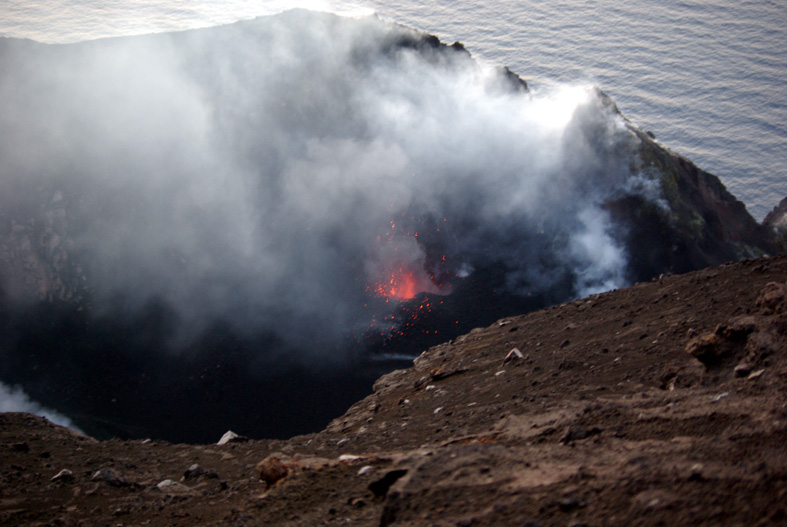
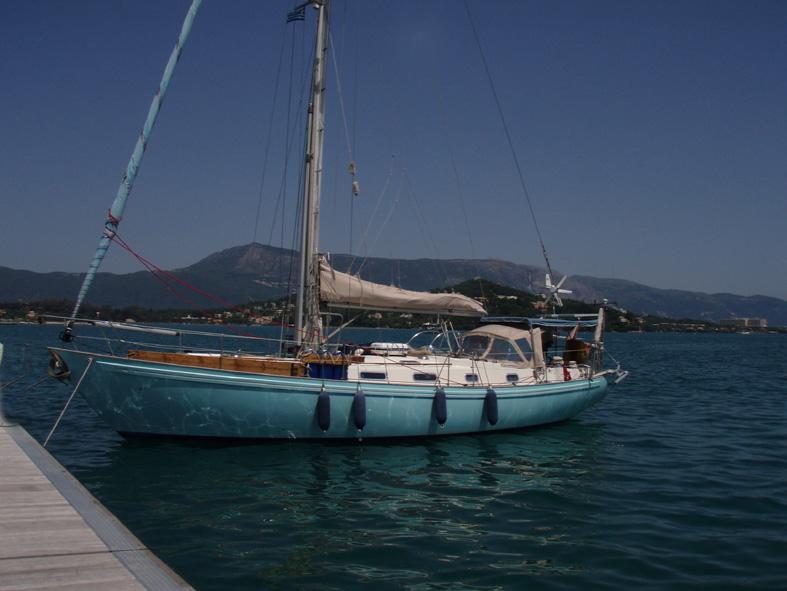
We would never have believed that we would still be here in Vibo Valentia in the middle of April, still waiting for spring to arrive. At Easter the weather was glorious and we thought that spring had finally sprung, but alas we are now sitting out another gale, with the fenders grinding against the pontoon. It can't be too much longer before the Med settles down to it's blue sky and settled seas that we came for. Then we will be off to try and visit the Aeolian islands (Stromboli among them) before sprinting off to Corfu at the first opportunity. Maybe next week......
Time to tell you all what we have been up to for 6 whole months!
 |
| Vibo Marina from above |
Vibo Valentia Marina is a small satellite town with a couple of supermarkets, 4 cheap and good restaurants, around 5 butchers, several bakers, a dozen fruit and veg shops, and a weekly market selling all sorts of fresh seasonal products straight from the hills, household goods and cheap clothes. It has plenty to satisfy our day-to-day needs, except any form of organised entertainment. There is a one-carriage regional train that goes to the tourist towns of Tropea and Pizzo, the airport town of Lamezia and links to the mainline railway for trips to Rome and Naples, or south to Sicily.
The main town of Vibo Valentia is a 30 minute bus ride away on top of the ridge 600m above sea level, hidden away from marauding pirates in the days when they controlled the seas. The road twists and turns on its way up to the main town, in a slightly nerve-racking and queasy-stomach way. The main town has loads more shops and another weekly market. We were able to buy a mobile phone here (€99 for super-UMTS internet access, if that means anything to you) and a new laptop – all of which we achieved in stumbling Italian and sign language.
There is more in the way of entertainment up there, but the bus finishes at 8pm and doesn't run at all on Sundays or holidays or festivals, or strikes or any other reason they can come up with.
 |
| Trying to communicate in the local market |
Despite the fact that all the kids here learn English at school, they subsequently encounter very few visitors and they don't travel outside their country generally, so few have the confidence to speak any English at all. In Vibo, only the Canadian owner of the marina, one of the marina staff and one of the hardware shop workers speak English. So our Italian has come on well. Shame it is a useless language in any other country and that we will soon be in Greece, but our efforts were well appreciated and encouraged by the locals here in the town. In fact most of the people over 40 ish speak a regional dialect derived from Greek, similar but not the same as the Sicilian dialect. It came as a surprise to us when a local man apologised to us for his poor Italian. We thought we had just misheard him at first, but we came to understand that Italian is only his second language, and that explained a lot of the blank looks our attempts at communication were encountering.
You may have heard that Southern Italy is the poor half of the country, and that is certainly evident all around. The northern Italians have been known to say that 'Africa begins at Naples' which may be a little harsh on Africa.
The local mafia apparently has its tendrils in all aspects of life, but is virtually invisible to the visitor or tourist. Taxes are high and so are avoided at all costs, most transactions are completed cash only. The result is that roads are poorly maintained, footpaths non-existent, municipal facilities are basic and rubbish is dumped by the roadside and left to be someone else's problem. However the people are proud, exceptionally friendly, honest, and appear to be very content with life.
Their lives revolve around their family, the activities of the church (all-pervading catholicism here of course with no other competition for the congregation) and fashion for the younger generation. All are impeccably dressed and accessorised in the latest mode, even if it is bought cheaply from the market or the chinese shop. As a local told us, 'You either buy clothes or bread, you cannot afford both if you work here' .
A recent survey of Italians found over 90% of the respondents to be mostly content with their personal lives, despite the problems that are endemic in Italy, and in particular in the south. I doubt that figure would be matched in the UK somehow!

 |
| Fishermen mending nets in the port of Vibo Marina |
Our day to day life is very quiet, filled with the complexities of buying provisions without access to a car. It is like a 1950's life without mod cons but with expectations of high tech communications. A whole day can be occupied with a trip to Pizzo to recharge the mobile phone with internet access. This involves knowledge of the bus timetable, which is not generally available – described by a local policeman as 'simbolico'.
We buy our tickets at the petrol station opposite the sort of pavementy area which is the bus stop, unfettered by any form of a sign indicating that the bus stops there. The 11am bus eluded us for 3 months until we discovered that it leaves from a different unmarked stop out of sight. The man who sells the bus tickets never felt it his duty to tell us that, although to be fair he most definitely has his own car, so why should he know or care? He has been known to sell us all return tickets, and whilst giving us the change, kindly impart the information 'no bus today – festa (festival)!'
Waiting at the unmarked bus-stop wondering if the bus will come today, gives us plenty of opportunity to observe 'Italians in cars'. For a start, the bus stop is at a 5 road unmarked intersection, with no indicated right of way, give way or stop signs. Today we watched them tarmac-ing part of this intersection - no diversion, no traffic control, and as soon as the roller had completed a few passes of flattening, the cars were threading their way around the trucks and tearing up the new tarmac with their tyres. One car had to be stopped from passing between the tarmac laying machine and the roller behind, before he was buried in the congealing tarmac.
On an average day, double or triple parking is the norm, leaving the car running, often the kids inside sitting on the dash, while they pop in to buy their cigs and lotto cards. Parked 3-deep, does cause extra confusion at the 5-road intersection, but doesn't stop overtaking, slow them down, or make them put down their mobile phones. Italian driving is fast and furious, aggressive and assertive, with surprisingly few accidents given the state of the wibbly wobbly roads. We think that they are actually very good drivers, more attentive to their surroundings, pedestrians and other road users, than the sleepy risk-averse, over-regulated Brit driver who has mostly given up thinking for himself.
The bus driver has 2 mobile phones, so he often has to juggle both and direct the bus around hair-pin bends and hoot his horn at the blind bends so as to avoid excessive and unnecessary breaking which might shock the driver behind. All the while he will be maintaining a conversation with the passengers at the front of the bus. Needless to say, we have pretty much given up on cycling here, or walking along the roads at night, where there is most often no pavement at all to protect you from maximum-velocity cornering. There are frequent traffic jams as the full size bus tries to navigate impossibly narrow streets as the cars back up in front and behind the bus and mopeds, with helmetless drivers of course, whizz through any possible spaces. Of course the double parking adds to the fun, especially on crossings, corners, pavements and anywhere there's a space!

 |
| Nearby Pizzo |
The plus side is that we have often been offered lifts by local people as they couldn't comprehend what it is like to be without a car. They will go out of their way to help, and show their surprise at you choosing to walk or take the bus. Can you imagine getting a lift home from the manager of the supermarket with your heavy shopping in the UK in his private car, with his wife waiting patiently in the passenger seat? One of the advantages of being in a small local town, is that we really stick out as being different, and tourists are as rare as hen's teeth here at this time of year, so they are usually interested to try to talk to us, to help us out, and particularly to find out why we are here.
In order to preserve our sanity, and to have an excuse to get off the boat when it is gyrating about it's mooring lines in yet-another storm, we have taken the opportunity to make visits inland and further afield, Sicily, Sila mountains, UK, France, Malta, Rome again, Basilicata, Puglia and Southern Italy. Not bad for a 6 month stay, unless you're trying to balance a budget!!
A brief trip to Sicily (December)

Marlin (Martin and Linda) are our sole wintering buddies here in the marina. Their first winter visitors arrived to less than welcoming swell in the marina, and 'fed the fish' within minutes of being on-board. A spur-of-the-moment decision was made to visit Sicily by train, and to take the opportunity to see what sort of boating-winter-community we might be missing there.
An easy and cheap train ride got us to Catania in Sicily. What a fabulous city- the people even more friendly than here. The most amazing food market that we have seen to-date, full of colour and colourful people, vibrant and fresh, smelly and noisome.


We had no hesitation in booking a 4x4 trip to the active volcano of Etna, one of the biggest active volcanoes in the world, towering into the clouds above the bustling city of Catania. Unfortunately in the winter it is not possible to go right to the top of the volcano, as it is covered in snow, but our volcanology guide, Marco, made our trip extremely interesting, as he expertly negotiated a road made for cattle to take a short-cut up the side of the mountain. No tourist trip is without a whinge, and this time it was the totally inappropriately dressed and unprepared Germans, who arrived in summer clothing and shoes to ascend up to the snow line, off-road, for a 'walking' tour of an active volcano in December ! No surprises that they complained of being cold and uncomfortable in the back of a landrover and wanted to know how soon ve vould be going down!!
 |
| A volcanic 'bomb' |
 |
| The entrance to a lava cave |
|
Anyway we visited lava flows where nothing grows for hundred of years, lava tunnels where Etna has released it's fury horizontally, and currently inactive craters with volcanic bombs strewn around the edges. The best thing about Etna, is that it is constantly erupting, with a slow flow of lava travelling slowly down its side, since it's catastrophic eruption in 1669. Other volcanoes are thought to be more dangerous. For example Vesuvius has been built upon by the citizens of the outskirts of Naples because it has not erupted for so many years, but is thought to be bubbling away beneath the city, with explosive and volatile gases waiting for escape. Nearby Stromboli erupts violently every 20 minutes, belching rocks and fire into the sky, but at least venting its power constantly and fairly predictably.
In the 1669 eruption of Etna Catania was devastated, its castle and ancient Greek amphitheatre covered in molten lava. One of the lava tunnels resulting from this explosion is now the feature of an underground bar in Agora hostel. It also contains a river that appears to flow uphill, but certainly flows away from the sea. Weird. It had to be paddled in, preferably after midnight, as you can see!
 |
| The most unusual watering spot so far.... |


We went on to Syracuse and Martin, Linda and their guests went back to the boat. We had high hopes for Syracuse, but found no sign of any winter liveaboard community there, or much activity at all except ladies in fur-coats Christmas shopping in the upmarket shops, and the scrubbed and shiny old town, devoid of all character. Apparently if you meet the right people it is a fascinating city. It has a wealth of evidence of its past as one of the crucial settlements in the Mediterranean, controlling trade, interaction, warfare, and history of the many seafarers who used its port. Unfortunately all we got was bad tourist food and terrible service, more than once being turned out onto the street after a poor meal into the rain as soon as we had cleared our plates. I'm sure they can do better.
A Christmas to remember
We had been warned that Vibo would close down for Christmas. As we couldn't see how it could get much more closed we decided that we needed a holiday. So we tried to book a trip to a small ski resort in the nearby Sila National Park mentioned in the Rough Guide. All attempts to do so by internet or phone failed, so we (with Martin and Linda) hired a car to drive to the place where we wanted to go on holiday – Camigliatello. Here we encountered the most inept, obstructive and incompetent tourist information employee of all time. I began by asking if she spoke English. 'Parla Inglese?' She said no, and before I could respond in any language she said in huffy Italian, 'Well how can I help you if we don't speak the same language..?' We bristled and refused to be intimidated, and we persevered in terrible Italian. Eventually she managed to find beneath her desk a faded copy of the bus timetable from Cosenza (the only way to get there without a car) which had obviously been stuck to the inside of the window previously, as it still had the sticky tape attached. After much encouragement she begrudgingly made a photocopy.
Do you have a map of the town, or the ski area? 'Non' came the emphatic reply. We later found we could buy a very detailed one right across the street from her office. Despite 'the attitude' we managed to obtain a list of hotels in the area, with phone numbers, but no addresses. But then they would have been useless as we had no map!! After we had 'hassled' her with as many questions as we could possibly think of she went back to her seat and held hands with her boyfriend to gaze out onto the quiet street, no doubt reflecting on what a busy day she'd had – dealing with troublesome tourists who expect information from the tourist information office!!
After some exploration and negotiation we prebooked a hotel room for Christmas in the town, and returned to the boat very pleased with our accomplishments.
We chose well. The Hotel Sila was bustling at Christmas with Italian families. Only the lovely Caprice at reception spoke some English and we took the opportunity to trade language lessons.
The hotel had an entertainment room, where the crazy and amiable Francesco and his helpers worked tirelessly to keep the hotel guests occupied with karaoke, games and all sorts of other inexplicable pursuits. He spoke no English at all, but took every opportunity to involve us, willingly or not, in his exploits all around the hotel, including firing an Italian police pistol into his bedroom wall, treated with all seriousness until we worked out that we were firing blanks !!
 |
Francesco the crazy clown....how he made us laugh, although we didn't understand a word!!
Here we capture the moment with our 'Cheese recorder', his English words for a camera! |

It was a great insight into Italian family life. No-one drinks alcohol, other than half a glass of wine at dinner. The entertainment room was full every night, but not a glass of water, coffee or alcoholic drink passed their lips, well except for one glass of sickly Asti Spumante with cake at midnight on Christmas eve. We furtively smuggled bottles of wine and beer into the hotel and empty ones out again, so as not to attract attention. We really were the only non-Italians in the whole town.
We had a lovely day ski-ing up and down the 1-lift 2-run resort, which was really enough for our old and unacclimatised bodies. We also booked a day cross-country ski-ing which was a first for all of us, and is highly recommended. We decided to do the first part of the 'road of the 3 peaks' as it joins the 3 highest peaks along a picturesque and fairly flat piste, suitable for beginners like us, with views out over the whole National Park. We were dropped off by the Italian guide, shown how to put on our cross country skis ( and how to take them off) pointed in the right direction and then left to our own devices. We were making good progress at lunchtime as the mist closed in, and we decided to turn off the path to the mountain 'shelter' to eat our packed lunch. After an unexpectedly long time on this side-track we started to notice increasingly familiar landmarks in the fog, and increasingly suspected that we were going back the way we'd come. We couldn't believe that we could be lost on a single marked path, but we were. Thankfully there was a bar in a mountain refugio back at the start of the track, which we could perhaps smell our way back to, and we got back safe and sound, regardless of the now zero visibility. So much for the wonderful views. After the 18 kilometers we were ready for a drink or three and the refugio was welcoming with fantastic snacks and a big open fire. We lounged for a couple of hours, drunk a few beers and then were picked up and taken back to the hotel.
The poor visibility continued for several days and the temperature increased to make downhill ski-ing sludgy, so we went walking.

 |
| Who's afraid of the big bad wolf? |
Italians do not walk. They were all dressed in fashionable mountain gear, but they don't go out in the cold. There are extensive marked forest tracks around the resort, popular with hikers in the summer months. There had been a thaw going on for 2 weeks when we were there. Despite this, and there only being less than 30cm of snow on the tracks, there were no walkers other than us.
All footprints finished 20 steps from the nearest car park and we continued into the woods on virgin 2-week old snow........ And got lost again despite the well marked paths.
We found all sorts of interesting things though, like wolf footprints and frightened running bunny footprints, and thigh deep snow, After 2 or 3 hours we emerged onto a familiar track none the worse for our adventures, after finding our own footprints to retrace our route out.
In between all this exercise we ate great mountains of great mountain food and along the way had an unforgettable Christmas in good company.
We had high hopes for a lively New Year back in Vibo Marina, as it seemed that all the young people would return home from study or work in the north of Italy, to be with their families for the festive season.
We went out on New Years eve. Not a single bar or restaurant was open. Not a single person was to be seen until 11.30pm, when one family set up their fireworks in the deserted street, right in front of their car. Dad seemed to think it would be a good idea to get rid of an out-of-date flare, so he fired it out over the harbour, where in landed in the back of a fishing trawler. Ten minutes later with the flames leaping higher and higher into the air from the boat we suggested (with sign language) that he call the fire brigade, which he did. They were there in a minute and doused the flames successfully. Meanwhile the kids, holding armfuls of fireworks, let them off with complete confidence, under the car, and even under their brother bent over lighting another one. Remarkably other than the fishing boat burning in the distance there were no other accidents, but that was the excitement for New Year in Vibo Marina. We retired to our boats and sipped red wine.
The UK
We arrived back in our native land (well Steph's actually) in mid January after 18 months of absence. After continually struggling to be understood in other languages and cultures, it was such a relief to speak to people in shops, bars and restaurants and be understood, even in Suffolk, in our own language. We happily sought out technical information about all sorts of stuff that had been a mystery to us, and were pleasantly surprised to find that all the expensive customer service training in all aspects of UK business has been to good effect. We found (almost) everyone to be pleasant, friendly, interested and keen to help us, and without any prompting would go out of their way to answer our extensive questions about phones, trains, computers, sausage rolls, whatever......many and diverse things we found of interest after our long absence. What hadn't changed ......the weather!
We made up for the lack of diversity in our healthy Mediterranean diet by consuming large quantities of fish and chips, bacon and eggs, Chinese, Indian and especially Thai food. What bliss!
After 3 weeks of seeing friends and family, we were off to visit our friends Simon and Lizzie in Languedoc area and then to Malta courtesy of Ryanairs £10 flights.
 |
| Simon and Lizzie are the perfect hosts, in their beautiful home in view of the Pyrenees. |
Malta
We had a lovely time staying with Kate and Davy aboard Roamer, and meeting up with the Dawn Chaser, Moyle Rose, Birvidik and Liz and Dave who were getting some winter sun without their boat, Kjemperjek. All these people were in Lagos last winter, so it was fun to catch up with news and compare cruising notes past and future. Hopefully we will see them all again around the Greek islands this year.
Malta is a really interesting island and we did some touristy things, although like Italy many of the tourist attractions were closed for the winter months. The 1950's buses are real bone shakers, but are a great cheap way to get around.
Rome
Back to Rome for a few days to meet Janet, and to see some of the sights that we missed last time, including the Vatican and Sistine chapel. It is amazing that the Catholic church obtained so many treasures by default, and they now charge €22 a head for the priviledge of seeing them. And it is packed every single day of the year. Without a guide, expect to wait several hours to enter. It is full of treasures beyond belief, from all parts of the world.
Every church in Italy allows one beggar the priveledge of begging outside each church- if they distributed the entrance fee from the Vatican museums, there wouldn't be any beggars!
The Sistine chapel is a circus, it is so packed with tourists in a constant flow at all times. There is nothing in it except frescoes and tourists. There are frequent shouts from Mussoloni-like custodians telling us all not to take photos (as it is a holy place!), but as soon as he passes by, the masses of tourists snap away with flashes popping. It is offically forbidden to speak here, but it sounds like a cattle market.
 |
| If you can't beat them, join them....the Last Judgement in the Sistine Chapel |
Good visibility rewarded our strenous climb to the top of the Basilica of San Pietro (St Peter's). The home of so much fervent religious attention, it also affords great views over the city for those that choose the €7 option to climb the stairs to the top....and where does that income go we wonder......
The absolute highlight of Rome is a small and bizarre crypt below the church of Santa Maria della Concezione, where the Capuchin monks had dug up a cemetery and used the bones of their predecessors to decorate the rooms. The bones of 4000 monks are arranged in abstract patterns, light fittings made from leg bones, mosaics of shoulder bones, Janet and I (as you would expect from radiographers) could recognise every morsel. The message from the monks- 'What you are now we once were, what we are now you will become!' What on earth were they thinking, by digging up 4000 of their fellows to demonstrate that point?
 |
| The grim reaper oversees a room of skulls |
A photographic tour of Southern Italy.
Stuart's dad visited us in Vibo Valentia from NZ with his wife Yvonne. We hired a car and drove the length and breadth of Southern Italy, cameras deployed for maximum photographic opportunity.
Stu put his new camera to good use, hopefully you should notice an improvement in the quality of the shots from now on!
 |
| Spooky resemblance |
|
|
Our first picnic stop was a surprise, the Greek Temple of Hera, just 300m from the busy main road near Metaponto. This was once one of the three great Greek settlements in Southern Italy, or Magna Graecia as it was then. In 510BC Pythagoras was 'ere, though not much remains to show its former glory today. Nice picnic stop though!
Further north we stopped for the night at Alberobello, a village in Puglia which has around 1500 of these strange igloo-like houses built out of the abundant local stone. They were apparently built like this so they could be knocked down in a hurry to avoid taxes, and rebuilt once the taxman had left town. Now they are mostly tourist shops, holiday homes or residences. We stayed in one for a night – we felt quite at home as we are used to living in a small space.
 |
| Alberobello |
 |
| A trulli house |
Next stop we visited
Matera in Basilicata, a ravine containing thousands of sassi or caves - its main claim to fame as the set used for Mel Gibson's 'The Passion of the Christ'.
During the 1950's 15000 people were forcibly evicted from their insanitary cave dwellings to rehouse them in modern tower blocks. Their homes were boarded up to prevent them from returning to the life they were accustomed to.
Many of the caves have been made into hotels or bijou dwellings but it is still possible to walk into the caves that have been left uninhabited, to see the sort of space they shared with their animals. We stayed overnight in very plush cave, which one day would have looked like the one below, but now has an ensuite bathroom and wifi!
At night it is eerie, dark and silent.
Further south we stopped at Rossano to see a sixth century Purple Codex, brought from the Holy Land by monks fleeing persecution. It depicts the life of Christ. It was a fascinating insight into early Christian art, very different from the hell-and-damnation imagery of the Sistine chapel.
 |
| 6th century manuscript at Rossano |
Time was getting on and we needed to book into a hotel for the night. We were told that there was only one hotel in this hilltop town, and it had only opened 2 weeks ago. We were the first tourists to stay in this self-appointed 3-star Fawlty Towers. Everything was complete confusion, including the price. But breakfast was the funniest part - as usual they served up horrid long-life croissants and coffee. We had to ask for plates to put them on. They must have heard that English people like cornflakes, but they are an alien concept to Italians, and not exactly knowing what to do with them, they were placed in the middle of the table in one small bowl with a spoon – for 4 people, with no milk! Priceless! They obviously thought we would sprinkle them on our croissants or in our coffee?
Next day we drove via Santa Severina, perched in the clouds on an isolated rocky peak with a huge fortress to protect the inhabitants from various aggressors during its history. The approach road was so steep it required first gear to coach our little rental car to the top. Stuart's ( the driver) nerves required some time to recover before the return trip down.
 |
| Santa Severina |
After this we drove cross country in blind fog to the Sila mountains and stayed the night again in our Christmas hotel. It was very quiet in the town now, and several people came to ask us why we were there and how we had found it. We can assure you that you will not find it through their marketing efforts but it is truly a place worth discovering. Steph resisted the urge to go and hassle the girl in the tourist information office with some more ridiculous questions. We awoke the next morning to a crisp clear day with a smattering of snow all around.
 |
| Sila mountains |
Next day we returned to Vibo via several traditional Italian hill towns, and learned that one of them, Nocera Tirenese, has a strange Easter tradition not to be missed. We promised to return on Easter Saturday.
When you hire a car in Italy, which is not cheap, you want to maximise the use of it. Next came a tour down to Reggio Calabria via a couple of towns. Palmi was interesting for its new court house specially constructed for mafia trials. The walls are so thick that they are bomb-proof and tank proof. Every inch of the building is covered by surveillance cameras. There didn't appear to be any trials that day, but they sure weren't keen on any photos!
The next town was supposed to be famous for its ceramic art work, according to the tourist signs and the guide book. However it appeared to us that the mafia drug barons had moved in and the locals were busy moving out. Every window was barred, and there was not a single business remaining open. The dusty streets were empty other than a few guys hanging around the central square. We were almost certainly followed out of town to ensure that we were just tourists. It was noticed in an entrance to a hill-side plot of land that “children had left a doll hanging in a noose in the entrance”. Not children, I suspect, and not an invitation to visit.
Reggio Calabria was a dump, or in the words of the Rough Guide, 'synonymous with urban decline'.
The Magna Graecia museum made an interesting stop, mainly for its Greek bronze statues, the Bronzi di Riace, discovered intact in the sea in 1972, in remarkably good condition given that they were cast around 450BC. The exhibit of their finds, and restoration looked really enthralling, but unfortunately all in Italian. We also had an unfortunate lunch in Reggio, which resulted in us leaving what we thought was a fair payment on the table and walking out. These people were happy to try and rip off visitors, Italian and foreign alike, every table had some sort of argument on paying their bills.Our single main course of King prawns, shared as a starter between 4, was charged at €80 instead of €20 because the boss lady decided we would want more than 1 portion. Of course, the credit card machine was out of action so all payments gratefully received in cash. They also substituted sea bream for sea bass without saying anything. It was the most disappointing and dispiriting attempts at a rip-off that we have encountered and completely out of our normal experience in the rest of Southern Italy. We didn't let it get to us.
Our last excursions with visitors, were more local, to the villages of Serra San Bruno, a pilgrim village in the heart of the Calabrian hills, Pizzo famous for its rich tartufo ice-cream (like eating a box of chocolates in one go) and touristy Tropea where we got great photos of Stromboli smoking 40 miles out to sea.
 |
| Bar Ercole, the proud producers of tartufo ice-cream at Pizzo |
 |
| The crumbling clifftop town of Tropea (famous for its sweet red onions) |
 |
| View of the Aeolian Islands |
After we waved Phil and Yvonne off to Rome, we went back to our boring lives for a week before Steph's mum arrived for a few days break. Spring kept trying to appear for a few days, then it was back to more storms, squeaking fenders and tiresome rolling. One night a bottle and 2 glasses of wine shot off the table into our laps, upholstery, floor – what a mess and what a waste!
We were determined to visit Nocera Tirenese for Easter Saturday as it sounded so bizarre – and it was. We had to have a hire car to get there, as it is nowhere near public transport, being a small hilltop town above Lamezia. They are quietly known for their perpetuation of a medieval ritual of flagellation. The flagellation consists of men running around the town beating their legs with a spiked pad until they bleed profusely. The blood splatters and runs over the road and houses. Each one is assisted by another young man on a lead or tether and carrying a cross, and another carrying red wine to douse the injuries to protect infection.

It was indeed a bizarre sight but also quite moving at times. The whole village joins in the processions and many still do the flagellating bit. We were surprised just how many were involved.
Near the end of the day we were invited into a villagers home for wine and snacks and we got a better understanding of what it's all about. Suffice to say that they are paying penitence for the sins of mankind, not trying to save their own skins, although they do spend the day by blessing (splattering) all the houses of friends and families and every church and shrine. The streets literally run with blood and it is real!


What surprised us is that they are educated people. The children of the family who invited us in, study at Rome University and spoke some English. Their father passed by to bless the family home with his blood, following in the footsteps of his father, who was present to admire his commitment. The youngest son held his father's leash and carried the cross all day, so that he might be privileged enough to one day have the honour to flagellate for his own family.
As well as the flagellation, the pietà (the Virgin Mary supporting the dead body of Christ) is carried around the town and taken to bless every single house in turn, receiving a floral tribute at every stop. It is accompanied by the old ladies of the village singing mournful lamentations about the pain of the death of Christ. The pietà is then carried up through the narrow streets to the ruins of the monastery at the top of a steep hill, where everyone stops for refreshment and to have their photos taken with the icon.
 |
| Nocera Terinese |
Easter Sunday here in
Vibo Marina was a fantastic day and possibly the hottest this year, and thatnight was possibly the worst and we had snow back on the hills again.
Vibo's Easter procession, although we're not sure on the significance, is celebrated by a charge up and down the main street at a full sprint carrying 3 floats, a Madonna, and two Jesus ones. They seem to race each other and meet in the middle of the junction to much cheering and clapping, fireworks and a release of balloons. Then it's a brisk parade back to the church. We would never have imagined that so many people live in Vibo Marina and around. Where have they all been hiding during the winter?


Within an hour the streets went from packed with Italians in their Sunday best, to totally deserted.When they say that Italians have Easter at home they don't mean most of them. They mean ALL of them, without exception, until about 4.30pm when the passagio ( strolling on the sea front) was the busiest we have ever seen for 4 hours and then they all scurry away home again and the place is deserted once more. One thing that we found throughout the area around Easter, was that every single church was packed to capacity at every service, a situation that British clergy could only dream of.
 |
Steve, Steph, Martin, Linda, Francesca, Lisa, Pedro and Stu
April 22nd 2008 |
We are back to doing last minute jobs on the boat again so that we can take advantage of the next weather slot to leave Vibo for new pastures. We're glad that circumstances forced us to stop here, and absorb the culture of small-town Italian life, and forced us to learn another language in order to interact with the local people. We have been making our last visits to our favourite restaurants. Il Saraceno – best pizza in the world (out of the marina, turn left and its at the end of the seafront) where they gave us a vacuum packed gift of nduja, a spicy pig spread that livens up any meal. It was really thoughtful of them to pack it so that it will last for months in our onboard fridge. At Pedro's our last night was made special by a last operatic rendition of Ave Maria by Francesca. She is 1 year into 7 years of training to sing opera and we promised that we would return to Italy when she first sings at the opera houses of Naples or Catania. Here's a photo to prove we knew her before she was famous!